

-
1 structural designing
Архитектура: проектирование конструкций, строительное проектирование -
2 design
- рисунок
- расчетное давление
- расчёт
- рассчитывать
- разрабатывать
- проектировать
- проектирование
- предназначать
- постановка
- намерение
- конструкция
- конструктивное решение
- замысел
- встраивать
- внешнее оформление
внешнее оформление
дизайн
—
[Я.Н.Лугинский, М.С.Фези-Жилинская, Ю.С.Кабиров. Англо-русский словарь по электротехнике и электроэнергетике, Москва, 1999 г.]Тематики
- электротехника, основные понятия
Синонимы
EN
встраивать
—
[Я.Н.Лугинский, М.С.Фези-Жилинская, Ю.С.Кабиров. Англо-русский словарь по электротехнике и электроэнергетике, Москва, 1999 г.]Тематики
- электротехника, основные понятия
EN
конструкция
Устройство, взаимное расположение частей и состав машины, механизма или сооружения.
[ http://sl3d.ru/o-slovare.html]Параллельные тексты EN-RU
The new valve profile is design to ensure smooth and precise control at low capacities for improved part load performances.
[Lennox]Вентиль новой конструкции обеспечивает плавное и точное регулирование при низкой производительности холодильного контура, что увеличивает его эффективность при неполной нагрузке.
[Интент]
Тематики
EN
постановка
(напр. опыта, эксперимента)
[А.С.Гольдберг. Англо-русский энергетический словарь. 2006 г.]Тематики
EN
предназначать
—
[Я.Н.Лугинский, М.С.Фези-Жилинская, Ю.С.Кабиров. Англо-русский словарь по электротехнике и электроэнергетике, Москва, 1999 г.]Тематики
- электротехника, основные понятия
EN
проектирование
Процесс разработки и выпуска проектной документации, необходимой для строительства объекта
[Терминологический словарь по строительству на 12 языках (ВНИИИС Госстроя СССР)]
проектирование
(ITIL Service Design)
Деятельность или процесс, который идентифицирует требования и далее определяет решение, способное удовлетворить этим требованиям.
См. тж. проектирование услуг.
[Словарь терминов ITIL версия 1.0, 29 июля 2011 г.]EN
design
(ITIL Service Design) An activity or process that identifies requirements and then defines a solution that is able to meet these requirements.
See also service design.
[Словарь терминов ITIL версия 1.0, 29 июля 2011 г.]Тематики
- проектирование, документация
EN
- construction
- design
- design engineering
- design planning
- design practice
- design procedure
- design study
- design work
- designing
- designing practice
- designing procedure
- designing work
- development
- development work
- drafting
- engineering
- laying
- laying-out
- planning
- project engineering
- project management
- projecting
- projection
DE
FR
проектировать
—
[Я.Н.Лугинский, М.С.Фези-Жилинская, Ю.С.Кабиров. Англо-русский словарь по электротехнике и электроэнергетике, Москва, 1999 г.]Тематики
- электротехника, основные понятия
EN
рассчитывать
—
[Я.Н.Лугинский, М.С.Фези-Жилинская, Ю.С.Кабиров. Англо-русский словарь по электротехнике и электроэнергетике, Москва, 1999 г.]Тематики
- электротехника, основные понятия
EN
расчёт
—
[Я.Н.Лугинский, М.С.Фези-Жилинская, Ю.С.Кабиров. Англо-русский словарь по электротехнике и электроэнергетике, Москва, 1999 г.]Тематики
- электротехника, основные понятия
EN
рисунок
Графическое изображение на плоскости, создаваемое с помощью линий, штрихов, пятен, точек.
[ ГОСТ Р 7.0.3-2006]Тематики
- издания, основные виды и элементы
Обобщающие термины
EN
DE
FR
3.21 проектирование (design): Все связанные виды инженерной деятельности, необходимые для разработки проекта трубопровода, включая как конструирование, так и подбор материалов и защиту от коррозии.
Источник: ГОСТ Р 54382-2011: Нефтяная и газовая промышленность. Подводные трубопроводные системы. Общие технические требования оригинал документа
3.75 расчетное давление (pressure, design): Максимальное внутреннее давление в течение обычной эксплуатации, отнесенное к указанной базисной высоте, по которому должен рассчитываться трубопровод или участок трубопровода.
Примечание - Расчетное давление должно учитывать условия стационарного течения на всем диапазоне значений расхода, а также возможные условия засорения и отключения для всей длины трубопровода или участка трубопровода, который должен находиться под постоянным расчетным давлением.
Источник: ГОСТ Р 54382-2011: Нефтяная и газовая промышленность. Подводные трубопроводные системы. Общие технические требования оригинал документа
Англо-русский словарь нормативно-технической терминологии > design
-
3 construction
здание
Наземное сооружение с помещениями для проживания, деятельности людей, хранения сырья или продукции или содержания животных.
[Терминологический словарь по строительству на 12 языках (ВНИИИС Госстроя СССР)]
здание
Наземное строительное сооружение с помещениями для проживания и (или) деятельности людей, размещения производств, хранения продукции или содержания животных
[ ГОСТ Р 52086-2003]
здание
Строительная система, состоящая из несущих и ограждающих или совмещенных несущих и ограждающих конструкций, образующих наземный замкнутый объем, предназначенный для проживания или пребывания людей в зависимости от функционального назначения и для выполнения различного вида производственных процессов.
[РД 01.120.00-КТН-228-06]
здание
Покрытая крышей конструкция со стенами, в которой энергия применяется для создания определенных условий внутри помещения. В качестве здания может рассматриваться здание целиком или его часть, спроектированная или перестроенная для отдельной эксплуатации.
[ДИРЕКТИВА 2002/91/ЕС ЕВРОПЕЙСКОГО ПАРЛАМЕТА И СОВЕТА от 16 декабря 2002 г. по энергетическим характеристикам зданий]
здание
Результат строительства, представляющий собой объемную строительную систему, имеющую надземную и (или) подземную части, включающую в себя помещения, сети инженерно-технического обеспечения и системы инженерно-технического обеспечения и предназначенную для проживания и (или) деятельности людей, размещения производства, хранения продукции или содержания животных.
[Технический регламент о безопасности зданий и сооружений]
здание
Результат строительства, представляющий собой объемную строительную систему, имеющую надземную и (или) подземную части, включающую в себя помещения, сети и системы инженерно-технического обеспечения и предназначенную для проживания и (или) деятельности людей, размещения производства, хранения продукции или содержания животных [4].
Примечание - Данное определение может относиться к зданию в целом или к отдельным частям здания, которые могут использоваться отдельно.
[ ГОСТ Р 54860-2011]- Промышленные здания
-
Общественные здания
-
учреждения и организации управления, финансирования, кредитования, госстраха, просвещения, дошкольные;
- библиотеки, архивы;
- предприятия торговли, общепита, бытового обслуживания населения;
- гостиницы;
- лечебные учреждения;
- музеи;
- зрелищные предприятия и спортивные сооружения
-
учреждения и организации управления, финансирования, кредитования, госстраха, просвещения, дошкольные;
- Жилые здания
Части здания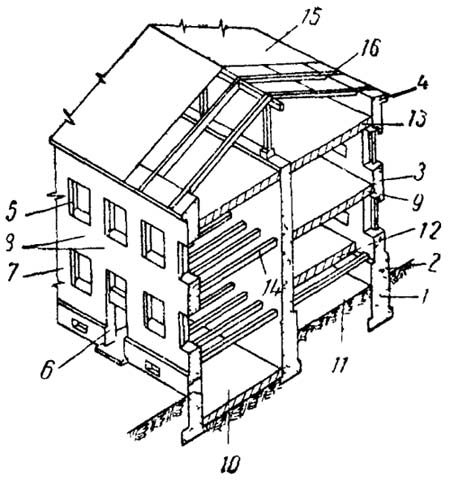
1 - фундамент;
2 - цоколь;
3 - поле стены (лицевая поверхность стены);
4 - карниз;
5 - оконный проем;
6 - дверной проем;
7 - простенок;
8 - перемычка (часть стены, перекрывающая оконные или дверные проемы);
9 - междуэтажное перекрытие;
10 - подвал;
11 - подполье;
12 - нижнее перекрытие;
13 - чердачное перекрытие;
14 - балки;
15 - кровля;
16 - стропила;
(15+16) - крыша[Грингауз Ф.И. Слесарь-жестянщик по промышленной вентиляции. Госстройиздат, 1959. 264 стр.]
Тематики
- здания, сооружения, помещения
- магистральный нефтепроводный транспорт
- опалубка
- теплоснабжение зданий
- энергосбережение
EN
DE
FR
конструкция
Устройство, взаимное расположение частей и состав машины, механизма или сооружения.
[ http://sl3d.ru/o-slovare.html]Параллельные тексты EN-RU
The new valve profile is design to ensure smooth and precise control at low capacities for improved part load performances.
[Lennox]Вентиль новой конструкции обеспечивает плавное и точное регулирование при низкой производительности холодильного контура, что увеличивает его эффективность при неполной нагрузке.
[Интент]
Тематики
EN
проектирование
Процесс разработки и выпуска проектной документации, необходимой для строительства объекта
[Терминологический словарь по строительству на 12 языках (ВНИИИС Госстроя СССР)]
проектирование
(ITIL Service Design)
Деятельность или процесс, который идентифицирует требования и далее определяет решение, способное удовлетворить этим требованиям.
См. тж. проектирование услуг.
[Словарь терминов ITIL версия 1.0, 29 июля 2011 г.]EN
design
(ITIL Service Design) An activity or process that identifies requirements and then defines a solution that is able to meet these requirements.
See also service design.
[Словарь терминов ITIL версия 1.0, 29 июля 2011 г.]Тематики
- проектирование, документация
EN
- construction
- design
- design engineering
- design planning
- design practice
- design procedure
- design study
- design work
- designing
- designing practice
- designing procedure
- designing work
- development
- development work
- drafting
- engineering
- laying
- laying-out
- planning
- project engineering
- project management
- projecting
- projection
DE
FR
размещение
—
[Я.Н.Лугинский, М.С.Фези-Жилинская, Ю.С.Кабиров. Англо-русский словарь по электротехнике и электроэнергетике, Москва, 1999 г.]Тематики
- электротехника, основные понятия
EN
3.3 конструкция (construction): Сварное изделие, сооружение или любая другая сварная продукция.
Источник: ГОСТ Р ИСО 3834-1-2007: Требования к качеству выполнения сварки плавлением металлических материалов. Часть 1. Критерии выбора соответствующего уровня требований оригинал документа
Англо-русский словарь нормативно-технической терминологии > construction
-
4 method
1) метод; способ; средство2) система; порядок3) технология4) методика•- method of applying liquid lubrication - method of calculation - method of column analogy - method of comparison - method of connecting - method of determining bending moments by fixed points - method of directions - method of elastic arch - method of elastic weights - method of electric needles - method of exchange of members - method of firing - method of fixed points - method of images - method of initial parameters - method of joints - method of least squares - method of least work - method of limit equilibrium - method of minimum strain energy - method of moments - method of movement - method of operation - method of payment - method of planning - method of production - method of redundant reactions - method of rotations - method of sections - method of separate joint displacement - method of slopes - method of stowage - method of strain measurement method - method of substitute redundant members - method of successive approximations - method of successive corrections - method of training - method of transportation - method of working - method of zero moment points - methods of network planning and control - ad hoc method - advertising method - aero-projection method - air-permeability method - airslide method - approximation method - arbitrary proportions method - area moment method - artificial islands method - ball method of testing - bench method - bidding methods - brush method of treatment timber - building methods - caisson method - cantilever method of design - cassette method of production of thin-slab structures - central mixing method - centre drift method - centrifuge method - centroidal method of design - change-in-stress method - chemical injection method - closed building method - column analogy method of design - compressed-air method of tunnelling - concrete testing method - cone method - construction works quality control method - core-drill method - correlation method - cut-and-cover method - cut-and-try method - cylinder method - deflection method - design methods - development method - dip method - dipping method of treatment timber - effective method - electrolytic method - emulsified-asphalt penetration method - energy method - equal load increments method - equal strain method - error method - fabrication method - fixing method - float and chains method - flow-line conveyer method - force method - graphical method - heading method of tunnelling - hot-air heating standpipe method - hot penetration method - hydraulic fill method - impact method - kinematic method - lacquer film method - land-assembly methods - lift-slab method - limit equilibrium method - limit stage design method - line production method - loading method - magnaflux method - mechanical method by pumps - membrane method of waterproofing - mixed-in-place method - mock-up methods of design - modular ratio method - moire fringe method - moment area method - moment-distribution method - moment-of-inertia method of designing - mud-jack method - mulch method - near end moment distribution method - neutral-points method - non-destructive testing methods - normal method - packing methods - patented method of construction - penetration method - percussive pneumatic method of riveting - photo-elastic method of stress-determination - photo-elasticity method - pilot method - pilot tunnel method - pin-and-string method - pipe-bridge method - plastic method of design - plastic theory method - polarized light method - portal method of design - pounding method of curing concrete - production line method of construction - qualitative methods - quantitative methods - relaxation method - ring-and-ball method - rolled-on method - safe method of heat insulation - safety methods - sampling method - sand-bearing method of testing clay pipes - sand-island method - scheduling method - seismic method of prospecting - simultaneous construction method - slope deflection method - spatial self-fixation erection method - statistical analysis method - stovepipe pipe-laying method - strain-energy method - successive construction method - surface-coating method of waterproofing - synthetic method of restoration - thixotropic liquid method - tilt-up method - top-heading method - transfiguration method - trial-load method - turnover method - ultimate-strength method - ultrasonic pulse velocity method - void method of proportioning - volume method of concrete mix design - volumetric method - water-jet method of pile-driving - weight method - well-point method of excavation - work method - working stress method of design* * *метод, способ; система; порядок; методика; технология- method of analysis
- method of application
- method of attack
- method of bearing and distances
- method of bipolar coordinates
- method of calculation
- method of design
- method of detail survey
- method of elastic weights
- method of electric needles
- method of expansion into series
- method of fixed points
- method of intersection
- method of joint isolation
- method of least work
- methods of manufacture
- method of minimum strain energy
- method of moment distribution
- method of radiation
- method of redistribution of pressure
- method of sections
- method of steam jet
- methods of structural analysis
- method of successive approximations
- methods of testing
- method of water needles
- accepted method of building
- accepted method of house construction
- accurate method of analysis
- adhesive nail-on method
- admittance method
- advanced methods of concreting
- advance slope method
- aggregate exposure method
- air permeability method
- alternate methods
- American method
- analytical method of determining reactions
- API method of pile design
- approximate method
- approximation method
- area method
- area-moment method
- assembly methods
- Austrian method
- autogenous curing method
- balanced cantilever method
- Belgian method
- Benoto method
- bentonite method
- Billner method
- "bin" method
- boiling water method
- boom placement concreting method
- bricklaying methods
- building method
- building block module method
- cable method of rock stressing
- calculation method
- cantilever method
- Chicago method
- circular-arc method
- Coast-Survey method
- collapse method of structural design
- combined finite strip-finite element method
- compaction methods of clays
- conjugate beam method
- consistency measurement method
- construction methods
- construction and erection methods
- contiguous pile method
- continuous-flight augers method
- continuous-sample method of advance
- convergence method
- critical method
- critical path method
- Cross moment distribution method
- Cross method
- cross-section method
- current design methods
- cut-and-cover method
- dampproofing methods
- displacement method
- displacement method of advance
- dual-rail method
- dummy unit-load method
- dust-spot method
- Dutch cone method
- earth pressure balanced tunneling method
- elastic center method
- elastic weights method
- electric analogy method
- electric resisting method
- energy method
- equal friction method of duct sizing
- equal friction method
- equivalent load method
- erection method
- fast track construction methods
- fatigue test method
- finite difference method
- finite element method
- finite strip method
- flight auger method
- flotation caisson method
- flue loss method
- folded plate method of analysis
- force method
- free cantilever method of construction
- general method of analysis
- Glotzl hydraulic cell method
- Gow method
- Hardy Cross method
- housing appraisal method
- in-duct method
- industrialized methods of construction
- iterative method
- jack method
- jacking method
- lacquer curtain coating method
- laser beam method
- leap-frog method
- limit equilibrium method
- limit state method
- listening methods
- load factor design method
- mandrel method
- mathematical method of design
- matrix method of structural analysis
- maturity method
- measuring method
- mixed-mode method
- mix-in-place method
- modern building methods
- modular ratio method
- moiré fringe method
- moment-balance method
- nondestructive methods of tests
- normal method of quality control
- null method
- numerical method
- one-rail method
- optical square method
- permissible stress method
- phototheodolite method
- plastic methods of structural analysis
- plate count method
- precast concrete manufacturing methods
- pressuremeter method
- proven construction methods
- p-y method of pile design
- rapid test method
- ratio method of balancing
- rebound hammer method
- reference point method
- relaxation method
- reproducible methods
- resistivity method
- resonant-frequency method
- reverberant field method
- Rockwell method of hardness testing
- safe method
- safe working methods
- secant interlocking pile method
- secant pile method
- seismic method of surveying
- seismic reflection method
- seismic refraction method
- semiprobabilistic design method
- shear transfer method
- shock response method of pile testing
- sliding-wedge method
- slope deflection method
- solar radiation method
- sonic method
- special method of quality control
- standard test method
- static regain method of duct sizing
- static regain method
- statistical design method
- step-by-step method
- strength design method
- strength evaluation method
- successive approximations method
- suspended cantilever method
- swamp shooting method
- Tagg method
- tangent modulus method
- test methods
- Theis method
- thixotropic liquid method
- three-point method
- tilt-up method
- time-saving method of construction
- TNO method of analysis
- TNO method of pile testing
- transit and stadia method
- tremie method
- truss analogy method
- turn-of-nut method
- ultrasonic pulse velocity method
- vacuum concrete method of bridge construction
- valveless pulse-jet method
- vane shear method
- velocity reduction method of duct sizing
- velocity reduction method
- vibratory method
- Vickers method of hardness testing
- volume method of measuring aggregates
- warm water method
- water fog spray method
- western bricklaying method
- western method
- working-stress design method -
5 unit
прибор
– activity unit
– actuating unit
– adjusted unit
– adjustment unit
– antigenic unit
– antitoxin unit
– arithmetic unit
– as a unit
– assembly unit
– associated unit
– base unit
– be a stand-alone unit
– bead-making unit
– binary unit
– blackout unit
– boiler unit
– box unit
– breaking unit
– buffer unit
– caloricity unit
– centimeter-gram-second unit
– change-gear unit
– charge unit
– charging unit
– cleaning unit
– clock unit
– cobalt unit
– cold-air unit
– combing unit
– combustion unit
– comparator unit
– complete unit
– complexity unit
– component unit
– computing unit
– control unit
– cord unit
– coupling unit
– crosstalk unit
– data unit
– data-processing unit
– data-transmitter unit
– defective unit
– delay unit
– derived unit
– digital unit
– dimensionless unit
– display unit
– driver unit
– drum-boiler unit
– electrical unit
– electromagnetic unit
– elementary unit
– estimation unit
– execution unit
– exhaust unit
– feed unit
– fodder unit
– fundamental unit
– furnace unit
– generating unit
– generator-transformer unit
– gyro unit
– harvesting unit
– haulage unit
– hauling unit
– hulling unit
– hydrogenation unit
– hysteresis unit
– imaginary unit
– inker unit
– inking unit
– input unit
– input-output unit
– insertion unit
– interlocking unit
– keying unit
– library unit
– lighting unit
– load-bearing unit
– lock unit
– logging unit
– mass unit
– memory unit
– message unit
– meter-kilogram-second unit
– middle unit
– milking unit
– modular unit
– monetary unit
– monitor unit
– multiple unit
– multiplication-division unit
– multiplier unit
– multiplier-divider unit
– non-redundant unit
– noncoherent unit
– nozzle-trim unit
– off-line unit
– off-system unit
– oil pressure unit
– on-line unit
– operated unit
– operational unit
– output unit
– pack unit
– per unit
– per unit length
– photometric unit
– physical unit
– plug-in unit
– power unit
– prediction unit
– premodularized unit
– primary unit
– processing unit
– production unit
– propulsion unit
– pump unit
– radio-frequency unit
– rail-conditioning unit
– reaction-propulsion unit
– read-out unit
– recording unit
– recource unit
– reduce unit
– reflow unit
– regulating unit
– relative unit
– relay unit
– reproduction unit
– sample unit
– selection unit
– self-contained unit
– self-destruct unit
– sensing unit
– set up unit
– sheet-separating unit
– shift unit
– shot-blast unit
– signalling unit
– single-order unit
– size of unit
– slave unit
– slitting unit
– sorting unit
– sound unit
– sowing unit
– spare unit
– sprayer unit
– spring unit
– stand-by unit
– standard unit
– standby unit
– starting unit
– strobe unit
– structural unit
– submultiple unit
– synchro unit
– tail unit
– take as a unit
– test unit
– throw-away unit
– tolerance unit
– tracking unit
– traction unit
– translator unit
– TV camera unit
– unit arrangement
– unit bicircle
– unit call
– unit charge
– unit circle
– unit cost
– unit cube
– unit digit
– unit element
– unit face
– unit fraction
– unit heater
– unit hydrograph
– unit impulse
– unit interval
– unit is rejected
– unit load
– unit of area
– unit of information
– unit of length
– unit of measurement
– unit of output
– unit of work
– unit pack
– unit point
– unit power
– unit pressure
– unit process
– unit strain
– unit stress
– unit time
– unit triangular
– unit vector
– unit vulcanizer
– voluentary unit
– volume unit
– washing unit
– X-ray unit
absolute electrostatic unit — единица электростатическая абсолютная
arriving unit is rejected — входящее требование получает отказ
automatic fuel-control unit — <engin.> агрегат командно-топливный
data storage unit — <comput.> блок хранения данных
engine is installed as a unit — двигатель устанавливается в сборе
flashing light unit — < railways> головка проблесковая
line-scan conversion unit — преобразователь строчного стандарта
load distribution unit — <engin.> блок распределения нагрузки
load following unit — <engin.> блок маневренный
natural unit of information — натуральная единица информации
nuclear propulsion unit — <cosm.> двигатель атомный
nuclear steam-raising unit — <constr.> установка паропроизводная ядерная
oscillator amplifier unit — < radio> блок генераторно-усилительный
power generating unit — <engin.> энергоблок
power supply unit — < radio> агрегат питания
separator pump unit — <energ.> станция компрессорная дожимная
servo control unit — <engin.> гидроусилитель
single-operator welding unit — однопостовая сварочная установка
thermal imaging unit — <math.> прибор тепловизионный, <tech.> тепловизор
threshold logic unit — <comput.> блок логический пороговый
two-operator welding unit — двухпостовая сварочная установка
unit power rating — <engin.> мощность удельная
-
6 design
<tech.gen> ■ Aufbau m<tech.gen> (process) ■ Ausführung f<tech.gen> (engineering; dimensioning etc., for certain loads) ■ Auslegung f ; konstruktive Auslegung f<tech.gen> ■ Bauart f ; Formgestaltung f ; Gestaltung f<tech.gen> (type, technical concept) ■ Konstruktion f ; konstruktive Gestaltung f<tech.gen> (structural shape) ■ Bauform f<tech.gen> (process of designing sth.; e.g. computer-aided) ■ Konstruktion f ; Konstruieren n<tech.gen> (abstract, idea) ■ Konstruktion f ; konstruktive Gestaltung f<tech.gen> (geometry, configuration) ■ Konstruktion f ; Konfiguration f ; Entwurf mvt <tech.gen> (for a specific purpose; e.g. a bridge to accommodate certain loads) ■ auslegen vtvt <tech.gen> ■ gestalten vtvt <tech.gen> (e.g. a component, machine, system) ■ konstruieren vt<tech.gen> (rated load plus safety margin; e.g. design pressure, design temperature) ■ Auslegungs...<tech.gen> (in compounds; e.g. temperature, pressure, speed) ■ Betriebs-...; Arbeits-... rar -
7 cost
1) стоимость, цена; себестоимость2) расход; счёт3) ком. оценивать•- cost of certification - cost of civil engineering works - cost of delivery - cost of designing - cost of erection works - cost of loading - cost of maintenance - cost of materials - cost of operation - cost of price - cost of service - cost of starting-up and adjustment works - cost of survey and research works - cost of transportation - cost of upkeep - above cost - actual cost of construction - added value cost - agreed cost - assembly cost - calculation of cost - capitalized cost - capitalized total cost - construction cost - current cost - direct labour cost - erection cost - estimated cost - extra cost - fabricating cost - final cost - flat cost - initial cost - inspection cost - installation cost - insurance cost - labour costs - low cost construction - maintenance costs - mounting cost - operating costs - original cost - overhaul cost - overhead costs - prime cost - purification costs - repair cost - running cost - standard cost - testing cost - training cost - unit cost - water cost - working costscost and maintenance (C&M) — содержание и обслуживание (обозначение статуса здания или оборудования, которое показывает, что в настоящее время в силу определённых причин объект не используется, но сохраняется в хорошем состоянии и может быть быстро введён в эксплуатацию)
* * *стоимость; pl расходы, затраты, издержки- cost of accident
- actual project cost
- adjusted base cost
- amortization costs
- average cost per man-hour
- basic cost
- capital cost
- carrying costs
- construction cost
- current costs
- daily operating costs
- delivery cost
- design costs
- design construction cost
- direct costs
- direct operating costs
- estimated cost
- estimated project costs
- fabrication cost
- first costs
- forecasting cost
- indirect costs
- labor costs
- labor costs for individual work items
- labor cost per hour
- life-cycle costs
- maintenance costs
- marketing costs
- material costs
- operating costs
- overhead costs
- penalty cost
- planning costs
- prime cost
- project cost
- prorated costs
- restoration costs
- road operation cost
- running cost
- site cost
- storage costs
- structural costs
- target cost
- traffic operation cost
- unit cost
- utility costs
- wage costs
- working costs -
8 engineer
-
9 unit
1) агрегат; установка2) блок; секция; узел; элемент; звено3) объект4) предмет6) единица || единичный7) шкала•unit in the large — мат. единица в целом
- auxiliary power unitto take as a unit — мат. принимать за единицу
- box unit- ground power unit - ground power-supply unit - infra-red heating unit - load distribution unit - load following unit - magnetic variation unit - nuclear steam-raising unit - pulse gating unit - pulse shaping unit - scrap breaking unit - service data unit - servo control unit - shared-path control unit - thermal imaging unit - threshold logic unit - two-phase milking unit -
10 framing
1. n создание, выработка2. n сооружение, конструирование3. n структура4. n рама, обрамление5. n сруб6. n каркасframing scaffold — леса, подмости
plank framing — дощатый каркас, каркас из досок
7. n кино. тлв. установка в рамку8. n спец. обмер леса рамой9. n горн. установка оклада10. n горн. заделка крепи11. n горн. мор. наборСинонимический ряд:1. upright beam (noun) joist; post; rafter; stud; timber; two by four; upright; upright beam2. contriving (verb) concocting; contriving; cooking up; dreaming up; hatching up; inventing; making up; vamping up3. laying (verb) drafting; draw up; drawing up; formulating; laying; preparing4. making (verb) assembling; building; constructing; erecting; fabricating; fashioning; forging; forming; making; manufacturing; molding; moulding; producing; put together; putting together; shaping5. planning (verb) blueprinting; casting; charting; designing; devising; planning; projecting -
11 Wright, Frank Lloyd
SUBJECT AREA: Architecture and building[br]b. 8 June 1869 Richland Center, Wisconsin, USAd. 9 April 1959 Phoenix, Arizona, USA[br]American architect who, in an unparalleled career spanning almost seventy years, became the most important figure on the modern architectural scene both in his own country and far further afield.[br]Wright began his career in 1887 working in the Chicago offices of Adler \& Sullivan. He conceived a great admiration for Sullivan, who was then concentrating upon large commercial projects in modern mode, producing functional yet decorative buildings which took all possible advantage of new structural methods. Wright was responsible for many of the domestic commissions.In 1893 Wright left the firm in order to set up practice on his own, thus initiating a career which was to develop into three distinct phases. In the first of these, up until the First World War, he was chiefly designing houses in a concept in which he envisaged "the house as a shelter". These buildings displayed his deeply held opinion that detached houses in country areas should be designed as an integral part of the landscape, a view later to be evidenced strongly in the work of modern Finnish architects. Wright's designs were called "prairie houses" because so many of them were built in the MidWest of America, which Wright described as a "prairie". These were low and spreading, with gently sloping rooflines, very plain and clean lined, built of traditional materials in warm rural colours, blending softly into their settings. Typical was W.W.Willit's house of 1902 in Highland Park, Illinois.In the second phase of his career Wright began to build more extensively in modern materials, utilizing advanced means of construction. A notable example was his remarkable Imperial Hotel in Tokyo, carefully designed and built in 1916–22 (now demolished), with special foundations and structure to withstand (successfully) strong earthquake tremors. He also became interested in the possibilities of reinforced concrete; in 1906 he built his church at Oak Park, Illinois, entirely of this material. In the 1920s, in California, he abandoned his use of traditional materials for house building in favour of precast concrete blocks, which were intended to provide an "organic" continuity between structure and decorative surfacing. In his continued exploration of the possibilities of concrete as a building material, he created the dramatic concept of'Falling Water', a house built in 1935–7 at Bear Run in Pennsylvania in which he projected massive reinforced-concrete terraces cantilevered from a cliff over a waterfall in the woodlands. In the later 1930s an extraordinary run of original concepts came from Wright, then nearing 70 years of age, ranging from his own winter residence and studio, Taliesin West in Arizona, to the administration block for Johnson Wax (1936–9) in Racine, Wisconsin, where the main interior ceiling was supported by Minoan-style, inversely tapered concrete columns rising to spreading circular capitals which contained lighting tubes of Pyrex glass.Frank Lloyd Wright continued to work until four days before his death at the age of 91. One of his most important and certainly controversial commissions was the Solomon R.Guggenheim Museum in New York. This had been proposed in 1943 but was not finally built until 1956–9; in this striking design the museum's exhibition areas are ranged along a gradually mounting spiral ramp lit effectively from above. Controversy stemmed from the unusual and original design of exterior banding and interior descending spiral for wall-display of paintings: some critics strongly approved, while others, equally strongly, did not.[br]Principal Honours and DistinctionsRIBA Royal Gold Medal 1941.Bibliography1945, An Autobiography, Faber \& Faber.Further ReadingE.Kaufmann (ed.), 1957, Frank Lloyd Wright: an American Architect, New York: Horizon Press.H.Russell Hitchcock, 1973, In the Nature of Materials, New York: Da Capo.T.A.Heinz, 1982, Frank Lloyd Wright, New York: St Martin's.DY -
12 Bibliography
■ Aitchison, J. (1987). Noam Chomsky: Consensus and controversy. New York: Falmer Press.■ Anderson, J. R. (1980). Cognitive psychology and its implications. San Francisco: W. H. Freeman.■ Anderson, J. R. (1983). The architecture of cognition. Cambridge, MA: Harvard University Press.■ Anderson, J. R. (1995). Cognitive psychology and its implications (4th ed.). New York: W. H. Freeman.■ Archilochus (1971). In M. L. West (Ed.), Iambi et elegi graeci (Vol. 1). Oxford: Oxford University Press.■ Armstrong, D. M. (1990). The causal theory of the mind. In W. G. Lycan (Ed.), Mind and cognition: A reader (pp. 37-47). Cambridge, MA: Basil Blackwell. (Originally published in 1981 in The nature of mind and other essays, Ithaca, NY: University Press).■ Atkins, P. W. (1992). Creation revisited. Oxford: W. H. Freeman & Company.■ Austin, J. L. (1962). How to do things with words. Cambridge, MA: Harvard University Press.■ Bacon, F. (1878). Of the proficience and advancement of learning divine and human. In The works of Francis Bacon (Vol. 1). Cambridge, MA: Hurd & Houghton.■ Bacon, R. (1928). Opus majus (Vol. 2). R. B. Burke (Trans.). Philadelphia, PA: University of Pennsylvania Press.■ Bar-Hillel, Y. (1960). The present status of automatic translation of languages. In F. L. Alt (Ed.), Advances in computers (Vol. 1). New York: Academic Press.■ Barr, A., & E. A. Feigenbaum (Eds.) (1981). The handbook of artificial intelligence (Vol. 1). Reading, MA: Addison-Wesley.■ Barr, A., & E. A. Feigenbaum (Eds.) (1982). The handbook of artificial intelligence (Vol. 2). Los Altos, CA: William Kaufman.■ Barron, F. X. (1963). The needs for order and for disorder as motives in creative activity. In C. W. Taylor & F. X. Barron (Eds.), Scientific creativity: Its rec ognition and development (pp. 153-160). New York: Wiley.■ Bartlett, F. C. (1932). Remembering: A study in experimental and social psychology. Cambridge: Cambridge University Press.■ Bartley, S. H. (1969). Principles of perception. London: Harper & Row.■ Barzun, J. (1959). The house of intellect. New York: Harper & Row.■ Beach, F. A., D. O. Hebb, C. T. Morgan & H. W. Nissen (Eds.) (1960). The neu ropsychology of Lashley. New York: McGraw-Hill.■ Berkeley, G. (1996). Principles of human knowledge: Three Dialogues. Oxford: Oxford University Press. (Originally published in 1710.)■ Berlin, I. (1953). The hedgehog and the fox: An essay on Tolstoy's view of history. NY: Simon & Schuster.■ Bierwisch, J. (1970). Semantics. In J. Lyons (Ed.), New horizons in linguistics. Baltimore: Penguin Books.■ Black, H. C. (1951). Black's law dictionary. St. Paul, MN: West Publishing.■ Bloom, A. (1981). The linguistic shaping of thought: A study in the impact of language on thinking in China and the West. Hillsdale, NJ: Erlbaum.■ Bobrow, D. G., & D. A. Norman (1975). Some principles of memory schemata. In D. G. Bobrow & A. Collins (Eds.), Representation and understanding: Stud ies in Cognitive Science (pp. 131-149). New York: Academic Press.■ Boden, M. A. (1977). Artificial intelligence and natural man. New York: Basic Books.■ Boden, M. A. (1981). Minds and mechanisms. Ithaca, NY: Cornell University Press.■ Boden, M. A. (1990a). The creative mind: Myths and mechanisms. London: Cardinal.■ Boden, M. A. (1990b). The philosophy of artificial intelligence. Oxford: Oxford University Press.■ Boden, M. A. (1994). Precis of The creative mind: Myths and mechanisms. Behavioral and brain sciences 17, 519-570.■ Boden, M. (1996). Creativity. In M. Boden (Ed.), Artificial Intelligence (2nd ed.). San Diego: Academic Press.■ Bolter, J. D. (1984). Turing's man: Western culture in the computer age. Chapel Hill, NC: University of North Carolina Press.■ Bolton, N. (1972). The psychology of thinking. London: Methuen.■ Bourne, L. E. (1973). Some forms of cognition: A critical analysis of several papers. In R. Solso (Ed.), Contemporary issues in cognitive psychology (pp. 313324). Loyola Symposium on Cognitive Psychology (Chicago 1972). Washington, DC: Winston.■ Bransford, J. D., N. S. McCarrell, J. J. Franks & K. E. Nitsch (1977). Toward unexplaining memory. In R. Shaw & J. D. Bransford (Eds.), Perceiving, acting, and knowing (pp. 431-466). Hillsdale, NJ: Lawrence Erlbaum Associates.■ Breger, L. (1981). Freud's unfinished journey. London: Routledge & Kegan Paul.■ Brehmer, B. (1986). In one word: Not from experience. In H. R. Arkes & K. Hammond (Eds.), Judgment and decision making: An interdisciplinary reader (pp. 705-719). Cambridge: Cambridge University Press.■ Bresnan, J. (1978). A realistic transformational grammar. In M. Halle, J. Bresnan & G. A. Miller (Eds.), Linguistic theory and psychological reality (pp. 1-59). Cambridge, MA: MIT Press.■ Brislin, R. W., W. J. Lonner & R. M. Thorndike (Eds.) (1973). Cross- cultural research methods. New York: Wiley.■ Bronowski, J. (1977). A sense of the future: Essays in natural philosophy. P. E. Ariotti with R. Bronowski (Eds.). Cambridge, MA: MIT Press.■ Bronowski, J. (1978). The origins of knowledge and imagination. New Haven, CT: Yale University Press.■ Brown, R. O. (1973). A first language: The early stages. Cambridge, MA: Harvard University Press.■ Brown, T. (1970). Lectures on the philosophy of the human mind. In R. Brown (Ed.), Between Hume and Mill: An anthology of British philosophy- 1749- 1843 (pp. 330-387). New York: Random House/Modern Library.■ Bruner, J. S., J. Goodnow & G. Austin (1956). A study of thinking. New York: Wiley.■ Calvin, W. H. (1990). The cerebral symphony: Seashore reflections on the structure of consciousness. New York: Bantam.■ Campbell, J. (1982). Grammatical man: Information, entropy, language, and life. New York: Simon & Schuster.■ Campbell, J. (1989). The improbable machine. New York: Simon & Schuster.■ Carlyle, T. (1966). On heroes, hero- worship and the heroic in history. Lincoln: University of Nebraska Press. (Originally published in 1841.)■ Carnap, R. (1959). The elimination of metaphysics through logical analysis of language [Ueberwindung der Metaphysik durch logische Analyse der Sprache]. In A. J. Ayer (Ed.), Logical positivism (pp. 60-81) A. Pap (Trans). New York: Free Press. (Originally published in 1932.)■ Cassirer, E. (1946). Language and myth. New York: Harper and Brothers. Reprinted. New York: Dover Publications, 1953.■ Cattell, R. B., & H. J. Butcher (1970). Creativity and personality. In P. E. Vernon (Ed.), Creativity. Harmondsworth, England: Penguin Books.■ Caudill, M., & C. Butler (1990). Naturally intelligent systems. Cambridge, MA: MIT Press/Bradford Books.■ Chandrasekaran, B. (1990). What kind of information processing is intelligence? A perspective on AI paradigms and a proposal. In D. Partridge & R. Wilks (Eds.), The foundations of artificial intelligence: A sourcebook (pp. 14-46). Cambridge: Cambridge University Press.■ Charniak, E., & McDermott, D. (1985). Introduction to artificial intelligence. Reading, MA: Addison-Wesley.■ Chase, W. G., & H. A. Simon (1988). The mind's eye in chess. In A. Collins & E. E. Smith (Eds.), Readings in cognitive science: A perspective from psychology and artificial intelligence (pp. 461-493). San Mateo, CA: Kaufmann.■ Cheney, D. L., & R. M. Seyfarth (1990). How monkeys see the world: Inside the mind of another species. Chicago: University of Chicago Press.■ Chi, M.T.H., R. Glaser & E. Rees (1982). Expertise in problem solving. In R. J. Sternberg (Ed.), Advances in the psychology of human intelligence (pp. 7-73). Hillsdale, NJ: Lawrence Erlbaum Associates.■ Chomsky, N. (1957). Syntactic structures. The Hague: Mouton. Janua Linguarum.■ Chomsky, N. (1964). A transformational approach to syntax. In J. A. Fodor & J. J. Katz (Eds.), The structure of language: Readings in the philosophy of lan guage (pp. 211-245). Englewood Cliffs, NJ: Prentice-Hall.■ Chomsky, N. (1965). Aspects of the theory of syntax. Cambridge, MA: MIT Press.■ Chomsky, N. (1972). Language and mind (enlarged ed.). New York: Harcourt Brace Jovanovich.■ Chomsky, N. (1979). Language and responsibility. New York: Pantheon.■ Chomsky, N. (1986). Knowledge of language: Its nature, origin and use. New York: Praeger Special Studies.■ Churchland, P. (1979). Scientific realism and the plasticity of mind. New York: Cambridge University Press.■ Churchland, P. M. (1989). A neurocomputational perspective: The nature of mind and the structure of science. Cambridge, MA: MIT Press.■ Churchland, P. S. (1986). Neurophilosophy. Cambridge, MA: MIT Press/Bradford Books.■ Clark, A. (1996). Philosophical Foundations. In M. A. Boden (Ed.), Artificial in telligence (2nd ed.). San Diego: Academic Press.■ Clark, H. H., & T. B. Carlson (1981). Context for comprehension. In J. Long & A. Baddeley (Eds.), Attention and performance (Vol. 9, pp. 313-330). Hillsdale, NJ: Lawrence Erlbaum Associates.■ Clarke, A. C. (1984). Profiles of the future: An inquiry into the limits of the possible. New York: Holt, Rinehart & Winston.■ Claxton, G. (1980). Cognitive psychology: A suitable case for what sort of treatment? In G. Claxton (Ed.), Cognitive psychology: New directions (pp. 1-25). London: Routledge & Kegan Paul.■ Code, M. (1985). Order and organism. Albany, NY: State University of New York Press.■ Collingwood, R. G. (1972). The idea of history. New York: Oxford University Press.■ Coopersmith, S. (1967). The antecedents of self- esteem. San Francisco: W. H. Freeman.■ Copland, A. (1952). Music and imagination. London: Oxford University Press.■ Coren, S. (1994). The intelligence of dogs. New York: Bantam Books.■ Cottingham, J. (Ed.) (1996). Western philosophy: An anthology. Oxford: Blackwell Publishers.■ Cox, C. (1926). The early mental traits of three hundred geniuses. Stanford, CA: Stanford University Press.■ Craik, K.J.W. (1943). The nature of explanation. Cambridge: Cambridge University Press.■ Cronbach, L. J. (1990). Essentials of psychological testing (5th ed.). New York: HarperCollins.■ Cronbach, L. J., & R. E. Snow (1977). Aptitudes and instructional methods. New York: Irvington. Paperback edition, 1981.■ Csikszentmihalyi, M. (1993). The evolving self. New York: Harper Perennial.■ Culler, J. (1976). Ferdinand de Saussure. New York: Penguin Books.■ Curtius, E. R. (1973). European literature and the Latin Middle Ages. W. R. Trask (Trans.). Princeton, NJ: Princeton University Press.■ D'Alembert, J.L.R. (1963). Preliminary discourse to the encyclopedia of Diderot. R. N. Schwab (Trans.). Indianapolis: Bobbs-Merrill.■ Dampier, W. C. (1966). A history of modern science. Cambridge: Cambridge University Press.■ Darwin, C. (1911). The life and letters of Charles Darwin (Vol. 1). Francis Darwin (Ed.). New York: Appleton.■ Davidson, D. (1970) Mental events. In L. Foster & J. W. Swanson (Eds.), Experience and theory (pp. 79-101). Amherst: University of Massachussetts Press.■ Davies, P. (1995). About time: Einstein's unfinished revolution. New York: Simon & Schuster/Touchstone.■ Davis, R., & J. J. King (1977). An overview of production systems. In E. Elcock & D. Michie (Eds.), Machine intelligence 8. Chichester, England: Ellis Horwood.■ Davis, R., & D. B. Lenat (1982). Knowledge- based systems in artificial intelligence. New York: McGraw-Hill.■ Dawkins, R. (1982). The extended phenotype: The gene as the unit of selection. Oxford: W. H. Freeman.■ deKleer, J., & J. S. Brown (1983). Assumptions and ambiguities in mechanistic mental models (1983). In D. Gentner & A. L. Stevens (Eds.), Mental modes (pp. 155-190). Hillsdale, NJ: Lawrence Erlbaum Associates.■ Dennett, D. C. (1978a). Brainstorms: Philosophical essays on mind and psychology. Montgomery, VT: Bradford Books.■ Dennett, D. C. (1978b). Toward a cognitive theory of consciousness. In D. C. Dennett, Brainstorms: Philosophical Essays on Mind and Psychology. Montgomery, VT: Bradford Books.■ Dennett, D. C. (1995). Darwin's dangerous idea: Evolution and the meanings of life. New York: Simon & Schuster/Touchstone.■ Descartes, R. (1897-1910). Traite de l'homme. In Oeuvres de Descartes (Vol. 11, pp. 119-215). Paris: Charles Adam & Paul Tannery. (Originally published in 1634.)■ Descartes, R. (1950). Discourse on method. L. J. Lafleur (Trans.). New York: Liberal Arts Press. (Originally published in 1637.)■ Descartes, R. (1951). Meditation on first philosophy. L. J. Lafleur (Trans.). New York: Liberal Arts Press. (Originally published in 1641.)■ Descartes, R. (1955). The philosophical works of Descartes. E. S. Haldane and G.R.T. Ross (Trans.). New York: Dover. (Originally published in 1911 by Cambridge University Press.)■ Descartes, R. (1967). Discourse on method (Pt. V). In E. S. Haldane and G.R.T. Ross (Eds.), The philosophical works of Descartes (Vol. 1, pp. 106-118). Cambridge: Cambridge University Press. (Originally published in 1637.)■ Descartes, R. (1970a). Discourse on method. In E. S. Haldane & G.R.T. Ross (Eds.), The philosophical works of Descartes (Vol. 1, pp. 181-200). Cambridge: Cambridge University Press. (Originally published in 1637.)■ Descartes, R. (1970b). Principles of philosophy. In E. S. Haldane & G.R.T. Ross (Eds.), The philosophical works of Descartes (Vol. 1, pp. 178-291). Cambridge: Cambridge University Press. (Originally published in 1644.)■ Descartes, R. (1984). Meditations on first philosophy. In J. Cottingham, R. Stoothoff & D. Murduch (Trans.), The philosophical works of Descartes (Vol. 2). Cambridge: Cambridge University Press. (Originally published in 1641.)■ Descartes, R. (1986). Meditations on first philosophy. J. Cottingham (Trans.). Cambridge: Cambridge University Press. (Originally published in 1641 as Med itationes de prima philosophia.)■ deWulf, M. (1956). An introduction to scholastic philosophy. Mineola, NY: Dover Books.■ Dixon, N. F. (1981). Preconscious processing. London: Wiley.■ Doyle, A. C. (1986). The Boscombe Valley mystery. In Sherlock Holmes: The com plete novels and stories (Vol. 1). New York: Bantam.■ Dreyfus, H., & S. Dreyfus (1986). Mind over machine. New York: Free Press.■ Dreyfus, H. L. (1972). What computers can't do: The limits of artificial intelligence (revised ed.). New York: Harper & Row.■ Dreyfus, H. L., & S. E. Dreyfus (1986). Mind over machine: The power of human intuition and expertise in the era of the computer. New York: Free Press.■ Edelman, G. M. (1992). Bright air, brilliant fire: On the matter of the mind. New York: Basic Books.■ Ehrenzweig, A. (1967). The hidden order of art. London: Weidenfeld & Nicolson.■ Einstein, A., & L. Infeld (1938). The evolution of physics. New York: Simon & Schuster.■ Eisenstein, S. (1947). Film sense. New York: Harcourt, Brace & World.■ Everdell, W. R. (1997). The first moderns. Chicago: University of Chicago Press.■ Eysenck, M. W. (1977). Human memory: Theory, research and individual difference. Oxford: Pergamon.■ Eysenck, M. W. (1982). Attention and arousal: Cognition and performance. Berlin: Springer.■ Eysenck, M. W. (1984). A handbook of cognitive psychology. Hillsdale, NJ: Lawrence Erlbaum Associates.■ Fancher, R. E. (1979). Pioneers of psychology. New York: W. W. Norton.■ Farrell, B. A. (1981). The standing of psychoanalysis. New York: Oxford University Press.■ Feldman, D. H. (1980). Beyond universals in cognitive development. Norwood, NJ: Ablex.■ Fetzer, J. H. (1996). Philosophy and cognitive science (2nd ed.). New York: Paragon House.■ Finke, R. A. (1990). Creative imagery: Discoveries and inventions in visualization. Hillsdale, NJ: Lawrence Erlbaum Associates.■ Flanagan, O. (1991). The science of the mind. Cambridge MA: MIT Press/Bradford Books.■ Fodor, J. (1983). The modularity of mind. Cambridge, MA: MIT Press/Bradford Books.■ Frege, G. (1972). Conceptual notation. T. W. Bynum (Trans.). Oxford: Clarendon Press. (Originally published in 1879.)■ Frege, G. (1979). Logic. In H. Hermes, F. Kambartel & F. Kaulbach (Eds.), Gottlob Frege: Posthumous writings. Chicago: University of Chicago Press. (Originally published in 1879-1891.)■ Freud, S. (1959). Creative writers and day-dreaming. In J. Strachey (Ed.), The standard edition of the complete psychological works of Sigmund Freud (Vol. 9, pp. 143-153). London: Hogarth Press.■ Freud, S. (1966). Project for a scientific psychology. In J. Strachey (Ed.), The stan dard edition of the complete psychological works of Sigmund Freud (Vol. 1, pp. 295-398). London: Hogarth Press. (Originally published in 1950 as Aus den AnfaЁngen der Psychoanalyse, in London by Imago Publishing.)■ Freud, S. (1976). Lecture 18-Fixation to traumas-the unconscious. In J. Strachey (Ed.), The standard edition of the complete psychological works of Sigmund Freud (Vol. 16, p. 285). London: Hogarth Press.■ Galileo, G. (1990). Il saggiatore [The assayer]. In S. Drake (Ed.), Discoveries and opinions of Galileo. New York: Anchor Books. (Originally published in 1623.)■ Gassendi, P. (1970). Letter to Descartes. In "Objections and replies." In E. S. Haldane & G.R.T. Ross (Eds.), The philosophical works of Descartes (Vol. 2, pp. 179-240). Cambridge: Cambridge University Press. (Originally published in 1641.)■ Gazzaniga, M. S. (1988). Mind matters: How mind and brain interact to create our conscious lives. Boston: Houghton Mifflin in association with MIT Press/Bradford Books.■ Genesereth, M. R., & N. J. Nilsson (1987). Logical foundations of artificial intelligence. Palo Alto, CA: Morgan Kaufmann.■ Ghiselin, B. (1952). The creative process. New York: Mentor.■ Ghiselin, B. (1985). The creative process. Berkeley, CA: University of California Press. (Originally published in 1952.)■ Gilhooly, K. J. (1996). Thinking: Directed, undirected and creative (3rd ed.). London: Academic Press.■ Glass, A. L., K. J. Holyoak & J. L. Santa (1979). Cognition. Reading, MA: AddisonWesley.■ Goody, J. (1977). The domestication of the savage mind. Cambridge: Cambridge University Press.■ Gruber, H. E. (1980). Darwin on man: A psychological study of scientific creativity (2nd ed.). Chicago: University of Chicago Press.■ Gruber, H. E., & S. Davis (1988). Inching our way up Mount Olympus: The evolving systems approach to creative thinking. In R. J. Sternberg (Ed.), The nature of creativity: Contemporary psychological perspectives. Cambridge: Cambridge University Press.■ Guthrie, E. R. (1972). The psychology of learning. New York: Harper. (Originally published in 1935.)■ Habermas, J. (1972). Knowledge and human interests. Boston: Beacon Press.■ Hadamard, J. (1945). The psychology of invention in the mathematical field. Princeton, NJ: Princeton University Press.■ Hand, D. J. (1985). Artificial intelligence and psychiatry. Cambridge: Cambridge University Press.■ Harris, M. (1981). The language myth. London: Duckworth.■ Haugeland, J. (Ed.) (1981). Mind design: Philosophy, psychology, artificial intelligence. Cambridge, MA: MIT Press/Bradford Books.■ Haugeland, J. (1981a). The nature and plausibility of cognitivism. In J. Haugeland (Ed.), Mind design: Philosophy, psychology, artificial intelligence (pp. 243-281). Cambridge, MA: MIT Press.■ Haugeland, J. (1981b). Semantic engines: An introduction to mind design. In J. Haugeland (Ed.), Mind design: Philosophy, psychology, artificial intelligence (pp. 1-34). Cambridge, MA: MIT Press/Bradford Books.■ Haugeland, J. (1985). Artificial intelligence: The very idea. Cambridge, MA: MIT Press.■ Hawkes, T. (1977). Structuralism and semiotics. Berkeley: University of California Press.■ Hebb, D. O. (1949). The organisation of behaviour. New York: Wiley.■ Hebb, D. O. (1958). A textbook of psychology. Philadelphia: Saunders.■ Hegel, G.W.F. (1910). The phenomenology of mind. J. B. Baille (Trans.). London: Sonnenschein. (Originally published as Phaenomenologie des Geistes, 1807.)■ Heisenberg, W. (1958). Physics and philosophy. New York: Harper & Row.■ Hempel, C. G. (1966). Philosophy of natural science. Englewood Cliffs, NJ: PrenticeHall.■ Herman, A. (1997). The idea of decline in Western history. New York: Free Press.■ Herrnstein, R. J., & E. G. Boring (Eds.) (1965). A source book in the history of psy chology. Cambridge, MA: Harvard University Press.■ Herzmann, E. (1964). Mozart's creative process. In P. H. Lang (Ed.), The creative world of Mozart (pp. 17-30). London: Oldbourne Press.■ Hilgard, E. R. (1957). Introduction to psychology. London: Methuen.■ Hobbes, T. (1651). Leviathan. London: Crooke.■ Holliday, S. G., & M. J. Chandler (1986). Wisdom: Explorations in adult competence. Basel, Switzerland: Karger.■ Horn, J. L. (1986). In R. J. Sternberg (Ed.), Advances in the psychology of human intelligence (Vol. 3). Hillsdale, NJ: Erlbaum.■ Hull, C. (1943). Principles of behavior. New York: Appleton-Century-Crofts.■ Hume, D. (1955). An inquiry concerning human understanding. New York: Liberal Arts Press. (Originally published in 1748.)■ Hume, D. (1975). An enquiry concerning human understanding. In L. A. SelbyBigge (Ed.), Hume's enquiries (3rd. ed., revised P. H. Nidditch). Oxford: Clarendon. (Spelling and punctuation revised.) (Originally published in 1748.)■ Hume, D. (1978). A treatise of human nature. L. A. Selby-Bigge (Ed.), Hume's enquiries (3rd. ed., revised P. H. Nidditch). Oxford: Clarendon. (With some modifications of spelling and punctuation.) (Originally published in 1690.)■ Hunt, E. (1973). The memory we must have. In R. C. Schank & K. M. Colby (Eds.), Computer models of thought and language. (pp. 343-371) San Francisco: W. H. Freeman.■ Husserl, E. (1960). Cartesian meditations. The Hague: Martinus Nijhoff.■ Inhelder, B., & J. Piaget (1958). The growth of logical thinking from childhood to adolescence. New York: Basic Books. (Originally published in 1955 as De la logique de l'enfant a` la logique de l'adolescent. [Paris: Presses Universitaire de France])■ James, W. (1890a). The principles of psychology (Vol. 1). New York: Dover Books.■ James, W. (1890b). The principles of psychology. New York: Henry Holt.■ Jevons, W. S. (1900). The principles of science (2nd ed.). London: Macmillan.■ Johnson, G. (1986). Machinery of the mind: Inside the new science of artificial intelli gence. New York: Random House.■ Johnson-Laird, P. N. (1983). Mental models: Toward a cognitive science of language, inference, and consciousness. Cambridge, MA: Harvard University Press.■ Johnson-Laird, P. N. (1988). The computer and the mind: An introduction to cognitive science. Cambridge, MA: Harvard University Press.■ Jones, E. (1961). The life and work of Sigmund Freud. L. Trilling & S. Marcus (Eds.). London: Hogarth.■ Jones, R. V. (1985). Complementarity as a way of life. In A. P. French & P. J. Kennedy (Eds.), Niels Bohr: A centenary volume. Cambridge, MA: Harvard University Press.■ Kant, I. (1933). Critique of Pure Reason (2nd ed.). N. K. Smith (Trans.). London: Macmillan. (Originally published in 1781 as Kritik der reinen Vernunft.)■ Kant, I. (1891). Solution of the general problems of the Prolegomena. In E. Belfort (Trans.), Kant's Prolegomena. London: Bell. (With minor modifications.) (Originally published in 1783.)■ Katona, G. (1940). Organizing and memorizing: Studies in the psychology of learning and teaching. New York: Columbia University Press.■ Kaufman, A. S. (1979). Intelligent testing with the WISC-R. New York: Wiley.■ Koestler, A. (1964). The act of creation. New York: Arkana (Penguin).■ Kohlberg, L. (1971). From is to ought. In T. Mischel (Ed.), Cognitive development and epistemology. (pp. 151-235) New York: Academic Press.■ KoЁhler, W. (1925). The mentality of apes. New York: Liveright.■ KoЁhler, W. (1927). The mentality of apes (2nd ed.). Ella Winter (Trans.). London: Routledge & Kegan Paul.■ KoЁhler, W. (1930). Gestalt psychology. London: G. Bell.■ KoЁhler, W. (1947). Gestalt psychology. New York: Liveright.■ KoЁhler, W. (1969). The task of Gestalt psychology. Princeton, NJ: Princeton University Press.■ Kuhn, T. (1970). The structure of scientific revolutions (2nd ed.). Chicago: University of Chicago Press.■ Langer, E. J. (1989). Mindfulness. Reading, MA: Addison-Wesley.■ Langer, S. (1962). Philosophical sketches. Baltimore: Johns Hopkins University Press.■ Langley, P., H. A. Simon, G. L. Bradshaw & J. M. Zytkow (1987). Scientific dis covery: Computational explorations of the creative process. Cambridge, MA: MIT Press.■ Lashley, K. S. (1951). The problem of serial order in behavior. In L. A. Jeffress (Ed.), Cerebral mechanisms in behavior, the Hixon Symposium (pp. 112-146) New York: Wiley.■ LeDoux, J. E., & W. Hirst (1986). Mind and brain: Dialogues in cognitive neuroscience. Cambridge: Cambridge University Press.■ Lehnert, W. (1978). The process of question answering. Hillsdale, NJ: Lawrence Erlbaum Associates.■ Leiber, J. (1991). Invitation to cognitive science. Oxford: Blackwell.■ Lenat, D. B., & G. Harris (1978). Designing a rule system that searches for scientific discoveries. In D. A. Waterman & F. Hayes-Roth (Eds.), Pattern directed inference systems (pp. 25-52) New York: Academic Press.■ Levenson, T. (1995). Measure for measure: A musical history of science. New York: Touchstone. (Originally published in 1994.)■ Leґvi-Strauss, C. (1963). Structural anthropology. C. Jacobson & B. Grundfest Schoepf (Trans.). New York: Basic Books. (Originally published in 1958.)■ Levine, M. W., & J. M. Schefner (1981). Fundamentals of sensation and perception. London: Addison-Wesley.■ Lewis, C. I. (1946). An analysis of knowledge and valuation. LaSalle, IL: Open Court.■ Lighthill, J. (1972). A report on artificial intelligence. Unpublished manuscript, Science Research Council.■ Lipman, M., A. M. Sharp & F. S. Oscanyan (1980). Philosophy in the classroom. Philadelphia: Temple University Press.■ Lippmann, W. (1965). Public opinion. New York: Free Press. (Originally published in 1922.)■ Locke, J. (1956). An essay concerning human understanding. Chicago: Henry Regnery Co. (Originally published in 1690.)■ Locke, J. (1975). An essay concerning human understanding. P. H. Nidditch (Ed.). Oxford: Clarendon. (Originally published in 1690.) (With spelling and punctuation modernized and some minor modifications of phrasing.)■ Lopate, P. (1994). The art of the personal essay. New York: Doubleday/Anchor Books.■ Lorimer, F. (1929). The growth of reason. London: Kegan Paul. Machlup, F., & U. Mansfield (Eds.) (1983). The study of information. New York: Wiley.■ Manguel, A. (1996). A history of reading. New York: Viking.■ Markey, J. F. (1928). The symbolic process. London: Kegan Paul.■ Martin, R. M. (1969). On Ziff's "Natural and formal languages." In S. Hook (Ed.), Language and philosophy: A symposium (pp. 249-263). New York: New York University Press.■ Mazlish, B. (1993). The fourth discontinuity: the co- evolution of humans and machines. New Haven, CT: Yale University Press.■ McCarthy, J., & P. J. Hayes (1969). Some philosophical problems from the standpoint of artificial intelligence. In B. Meltzer & D. Michie (Eds.), Machine intelligence 4. Edinburgh: Edinburgh University Press.■ McClelland, J. L., D. E. Rumelhart & G. E. Hinton (1986). The appeal of parallel distributed processing. In D. E. Rumelhart, J. L. McClelland & the PDP Research Group (Eds.), Parallel distributed processing: Explorations in the mi crostructure of cognition (Vol. 1, pp. 3-40). Cambridge, MA: MIT Press/ Bradford Books.■ McCorduck, P. (1979). Machines who think. San Francisco: W. H. Freeman.■ McLaughlin, T. (1970). Music and communication. London: Faber & Faber.■ Mednick, S. A. (1962). The associative basis of the creative process. Psychological Review 69, 431-436.■ Meehl, P. E., & C. J. Golden (1982). Taxometric methods. In Kendall, P. C., & Butcher, J. N. (Eds.), Handbook of research methods in clinical psychology (pp. 127-182). New York: Wiley.■ Mehler, J., E.C.T. Walker & M. Garrett (Eds.) (1982). Perspectives on mental rep resentation: Experimental and theoretical studies of cognitive processes and ca pacities. Hillsdale, NJ: Lawrence Erlbaum Associates.■ Mill, J. S. (1900). A system of logic, ratiocinative and inductive: Being a connected view of the principles of evidence and the methods of scientific investigation. London: Longmans, Green.■ Miller, G. A. (1979, June). A very personal history. Talk to the Cognitive Science Workshop, Cambridge, MA.■ Miller, J. (1983). States of mind. New York: Pantheon Books.■ Minsky, M. (1975). A framework for representing knowledge. In P. H. Winston (Ed.), The psychology of computer vision (pp. 211-277). New York: McGrawHill.■ Minsky, M., & S. Papert (1973). Artificial intelligence. Condon Lectures, Oregon State System of Higher Education, Eugene, Oregon.■ Minsky, M. L. (1986). The society of mind. New York: Simon & Schuster.■ Mischel, T. (1976). Psychological explanations and their vicissitudes. In J. K. Cole & W. J. Arnold (Eds.), Nebraska Symposium on motivation (Vol. 23). Lincoln, NB: University of Nebraska Press.■ Morford, M.P.O., & R. J. Lenardon (1995). Classical mythology (5th ed.). New York: Longman.■ Murdoch, I. (1954). Under the net. New York: Penguin.■ Nagel, E. (1959). Methodological issues in psychoanalytic theory. In S. Hook (Ed.), Psychoanalysis, scientific method, and philosophy: A symposium. New York: New York University Press.■ Nagel, T. (1979). Mortal questions. London: Cambridge University Press.■ Nagel, T. (1986). The view from nowhere. Oxford: Oxford University Press.■ Neisser, U. (1967). Cognitive psychology. New York: Appleton-Century-Crofts.■ Neisser, U. (1972). Changing conceptions of imagery. In P. W. Sheehan (Ed.), The function and nature of imagery (pp. 233-251). London: Academic Press.■ Neisser, U. (1976). Cognition and reality. San Francisco: W. H. Freeman.■ Neisser, U. (1978). Memory: What are the important questions? In M. M. Gruneberg, P. E. Morris & R. N. Sykes (Eds.), Practical aspects of memory (pp. 3-24). London: Academic Press.■ Neisser, U. (1979). The concept of intelligence. In R. J. Sternberg & D. K. Detterman (Eds.), Human intelligence: Perspectives on its theory and measurement (pp. 179-190). Norwood, NJ: Ablex.■ Nersessian, N. (1992). How do scientists think? Capturing the dynamics of conceptual change in science. In R. N. Giere (Ed.), Cognitive models of science (pp. 3-44). Minneapolis: University of Minnesota Press.■ Newell, A. (1973a). Artificial intelligence and the concept of mind. In R. C. Schank & K. M. Colby (Eds.), Computer models of thought and language (pp. 1-60). San Francisco: W. H. Freeman.■ Newell, A. (1973b). You can't play 20 questions with nature and win. In W. G. Chase (Ed.), Visual information processing (pp. 283-310). New York: Academic Press.■ Newell, A., & H. A. Simon (1963). GPS: A program that simulates human thought. In E. A. Feigenbaum & J. Feldman (Eds.), Computers and thought (pp. 279-293). New York & McGraw-Hill.■ Newell, A., & H. A. Simon (1972). Human problem solving. Englewood Cliffs, NJ: Prentice-Hall.■ Nietzsche, F. (1966). Beyond good and evil. W. Kaufmann (Trans.). New York: Vintage. (Originally published in 1885.)■ Nilsson, N. J. (1971). Problem- solving methods in artificial intelligence. New York: McGraw-Hill.■ Nussbaum, M. C. (1978). Aristotle's Princeton University Press. De Motu Anamalium. Princeton, NJ:■ Oersted, H. C. (1920). Thermo-electricity. In Kirstine Meyer (Ed.), H. C. Oersted, Natuurvidenskabelige Skrifter (Vol. 2). Copenhagen: n.p. (Originally published in 1830 in The Edinburgh encyclopaedia.)■ Ong, W. J. (1982). Orality and literacy: The technologizing of the word. London: Methuen.■ Onians, R. B. (1954). The origins of European thought. Cambridge, MA: Cambridge University Press.■ Osgood, C. E. (1960). Method and theory in experimental psychology. New York: Oxford University Press. (Originally published in 1953.)■ Osgood, C. E. (1966). Language universals and psycholinguistics. In J. H. Greenberg (Ed.), Universals of language (2nd ed., pp. 299-322). Cambridge, MA: MIT Press.■ Palmer, R. E. (1969). Hermeneutics. Evanston, IL: Northwestern University Press.■ Peirce, C. S. (1934). Some consequences of four incapacities-Man, a sign. In C. Hartsborne & P. Weiss (Eds.), Collected papers of Charles Saunders Peirce (Vol. 5, pp. 185-189). Cambridge, MA: Harvard University Press.■ Penfield, W. (1959). In W. Penfield & L. Roberts, Speech and brain mechanisms. Princeton, NJ: Princeton University Press.■ Penrose, R. (1994). Shadows of the mind: A search for the missing science of conscious ness. Oxford: Oxford University Press.■ Perkins, D. N. (1981). The mind's best work. Cambridge, MA: Harvard University Press.■ Peterfreund, E. (1986). The heuristic approach to psychoanalytic therapy. In■ J. Reppen (Ed.), Analysts at work, (pp. 127-144). Hillsdale, NJ: Analytic Press.■ Piaget, J. (1952). The origin of intelligence in children. New York: International Universities Press. (Originally published in 1936.)■ Piaget, J. (1954). Le langage et les opeґrations intellectuelles. Proble` mes de psycho linguistique. Symposium de l'Association de Psychologie Scientifique de Langue Francёaise. Paris: Presses Universitaires de France.■ Piaget, J. (1977). Problems of equilibration. In H. E. Gruber & J. J. Voneche (Eds.), The essential Piaget (pp. 838-841). London: Routlege & Kegan Paul. (Originally published in 1975 as L'eґquilibration des structures cognitives [Paris: Presses Universitaires de France].)■ Piaget, J., & B. Inhelder. (1973). Memory and intelligence. New York: Basic Books.■ Pinker, S. (1994). The language instinct. New York: Morrow.■ Pinker, S. (1996). Facts about human language relevant to its evolution. In J.-P. Changeux & J. Chavaillon (Eds.), Origins of the human brain. A symposium of the Fyssen foundation (pp. 262-283). Oxford: Clarendon Press. Planck, M. (1949). Scientific autobiography and other papers. F. Gaynor (Trans.). New York: Philosophical Library.■ Planck, M. (1990). Wissenschaftliche Selbstbiographie. W. Berg (Ed.). Halle, Germany: Deutsche Akademie der Naturforscher Leopoldina.■ Plato (1892). Meno. In The Dialogues of Plato (B. Jowett, Trans.; Vol. 2). New York: Clarendon. (Originally published circa 380 B.C.)■ Poincareґ, H. (1913). Mathematical creation. In The foundations of science. G. B. Halsted (Trans.). New York: Science Press.■ Poincareґ, H. (1921). The foundations of science: Science and hypothesis, the value of science, science and method. G. B. Halstead (Trans.). New York: Science Press.■ Poincareґ, H. (1929). The foundations of science: Science and hypothesis, the value of science, science and method. New York: Science Press.■ Poincareґ, H. (1952). Science and method. F. Maitland (Trans.) New York: Dover.■ Polya, G. (1945). How to solve it. Princeton, NJ: Princeton University Press.■ Polanyi, M. (1958). Personal knowledge. London: Routledge & Kegan Paul.■ Popper, K. (1968). Conjectures and refutations: The growth of scientific knowledge. New York: Harper & Row/Basic Books.■ Popper, K., & J. Eccles (1977). The self and its brain. New York: Springer-Verlag.■ Popper, K. R. (1959). The logic of scientific discovery. London: Hutchinson.■ Putnam, H. (1975). Mind, language and reality: Philosophical papers (Vol. 2). Cambridge: Cambridge University Press.■ Putnam, H. (1987). The faces of realism. LaSalle, IL: Open Court.■ Pylyshyn, Z. W. (1981). The imagery debate: Analog media versus tacit knowledge. In N. Block (Ed.), Imagery (pp. 151-206). Cambridge, MA: MIT Press.■ Pylyshyn, Z. W. (1984). Computation and cognition: Towards a foundation for cog nitive science. Cambridge, MA: MIT Press/Bradford Books.■ Quillian, M. R. (1968). Semantic memory. In M. Minsky (Ed.), Semantic information processing (pp. 216-260). Cambridge, MA: MIT Press.■ Quine, W.V.O. (1960). Word and object. Cambridge, MA: Harvard University Press.■ Rabbitt, P.M.A., & S. Dornic (Eds.). Attention and performance (Vol. 5). London: Academic Press.■ Rawlins, G.J.E. (1997). Slaves of the Machine: The quickening of computer technology. Cambridge, MA: MIT Press/Bradford Books.■ Reid, T. (1970). An inquiry into the human mind on the principles of common sense. In R. Brown (Ed.), Between Hume and Mill: An anthology of British philosophy- 1749- 1843 (pp. 151-178). New York: Random House/Modern Library.■ Reitman, W. (1970). What does it take to remember? In D. A. Norman (Ed.), Models of human memory (pp. 470-510). London: Academic Press.■ Ricoeur, P. (1974). Structure and hermeneutics. In D. I. Ihde (Ed.), The conflict of interpretations: Essays in hermeneutics (pp. 27-61). Evanston, IL: Northwestern University Press.■ Robinson, D. N. (1986). An intellectual history of psychology. Madison: University of Wisconsin Press.■ Rorty, R. (1979). Philosophy and the mirror of nature. Princeton, NJ: Princeton University Press.■ Rosch, E. (1977). Human categorization. In N. Warren (Ed.), Studies in cross cultural psychology (Vol. 1, pp. 1-49) London: Academic Press.■ Rosch, E. (1978). Principles of categorization. In E. Rosch & B. B. Lloyd (Eds.), Cognition and categorization (pp. 27-48). Hillsdale, NJ: Lawrence Erlbaum Associates.■ Rosch, E., & B. B. Lloyd (1978). Principles of categorization. In E. Rosch & B. B. Lloyd (Eds.), Cognition and categorization. Hillsdale, NJ: Lawrence Erlbaum Associates.■ Rose, S. (1970). The chemistry of life. Baltimore: Penguin Books.■ Rose, S. (1976). The conscious brain (updated ed.). New York: Random House.■ Rose, S. (1993). The making of memory: From molecules to mind. New York: Anchor Books. (Originally published in 1992)■ Roszak, T. (1994). The cult of information: A neo- Luddite treatise on high- tech, artificial intelligence, and the true art of thinking (2nd ed.). Berkeley: University of California Press.■ Royce, J. R., & W. W. Rozeboom (Eds.) (1972). The psychology of knowing. New York: Gordon & Breach.■ Rumelhart, D. E. (1977). Introduction to human information processing. New York: Wiley.■ Rumelhart, D. E. (1980). Schemata: The building blocks of cognition. In R. J. Spiro, B. Bruce & W. F. Brewer (Eds.), Theoretical issues in reading comprehension. Hillsdale, NJ: Lawrence Erlbaum Associates.■ Rumelhart, D. E., & J. L. McClelland (1986). On learning the past tenses of English verbs. In J. L. McClelland & D. E. Rumelhart (Eds.), Parallel distributed processing: Explorations in the microstructure of cognition (Vol. 2). Cambridge, MA: MIT Press.■ Rumelhart, D. E., P. Smolensky, J. L. McClelland & G. E. Hinton (1986). Schemata and sequential thought processes in PDP models. In J. L. McClelland, D. E. Rumelhart & the PDP Research Group (Eds.), Parallel Distributed Processing (Vol. 2, pp. 7-57). Cambridge, MA: MIT Press.■ Russell, B. (1927). An outline of philosophy. London: G. Allen & Unwin.■ Russell, B. (1961). History of Western philosophy. London: George Allen & Unwin.■ Russell, B. (1965). How I write. In Portraits from memory and other essays. London: Allen & Unwin.■ Russell, B. (1992). In N. Griffin (Ed.), The selected letters of Bertrand Russell (Vol. 1), The private years, 1884- 1914. Boston: Houghton Mifflin. Ryecroft, C. (1966). Psychoanalysis observed. London: Constable.■ Sagan, C. (1978). The dragons of Eden: Speculations on the evolution of human intel ligence. New York: Ballantine Books.■ Salthouse, T. A. (1992). Expertise as the circumvention of human processing limitations. In K. A. Ericsson & J. Smith (Eds.), Toward a general theory of expertise: Prospects and limits (pp. 172-194). Cambridge: Cambridge University Press.■ Sanford, A. J. (1987). The mind of man: Models of human understanding. New Haven, CT: Yale University Press.■ Sapir, E. (1921). Language. New York: Harcourt, Brace, and World.■ Sapir, E. (1964). Culture, language, and personality. Berkeley: University of California Press. (Originally published in 1941.)■ Sapir, E. (1985). The status of linguistics as a science. In D. G. Mandelbaum (Ed.), Selected writings of Edward Sapir in language, culture and personality (pp. 160166). Berkeley: University of California Press. (Originally published in 1929).■ Scardmalia, M., & C. Bereiter (1992). Literate expertise. In K. A. Ericsson & J. Smith (Eds.), Toward a general theory of expertise: Prospects and limits (pp. 172-194). Cambridge: Cambridge University Press.■ Schafer, R. (1954). Psychoanalytic interpretation in Rorschach testing. New York: Grune & Stratten.■ Schank, R. C. (1973). Identification of conceptualizations underlying natural language. In R. C. Schank & K. M. Colby (Eds.), Computer models of thought and language (pp. 187-248). San Francisco: W. H. Freeman.■ Schank, R. C. (1976). The role of memory in language processing. In C. N. Cofer (Ed.), The structure of human memory. (pp. 162-189) San Francisco: W. H. Freeman.■ Schank, R. C. (1986). Explanation patterns: Understanding mechanically and creatively. Hillsdale, NJ: Lawrence Erlbaum Associates.■ Schank, R. C., & R. P. Abelson (1977). Scripts, plans, goals, and understanding. Hillsdale, NJ: Lawrence Erlbaum Associates.■ SchroЁdinger, E. (1951). Science and humanism. Cambridge: Cambridge University Press.■ Searle, J. R. (1981a). Minds, brains, and programs. In J. Haugeland (Ed.), Mind design: Philosophy, psychology, artificial intelligence (pp. 282-306). Cambridge, MA: MIT Press.■ Searle, J. R. (1981b). Minds, brains and programs. In D. Hofstadter & D. Dennett (Eds.), The mind's I (pp. 353-373). New York: Basic Books.■ Searle, J. R. (1983). Intentionality. New York: Cambridge University Press.■ Serres, M. (1982). The origin of language: Biology, information theory, and thermodynamics. M. Anderson (Trans.). In J. V. Harari & D. F. Bell (Eds.), Hermes: Literature, science, philosophy (pp. 71-83). Baltimore: Johns Hopkins University Press.■ Simon, H. A. (1966). Scientific discovery and the psychology of problem solving. In R. G. Colodny (Ed.), Mind and cosmos: Essays in contemporary science and philosophy (pp. 22-40). Pittsburgh: University of Pittsburgh Press.■ Simon, H. A. (1979). Models of thought. New Haven, CT: Yale University Press.■ Simon, H. A. (1989). The scientist as a problem solver. In D. Klahr & K. Kotovsky (Eds.), Complex information processing: The impact of Herbert Simon. Hillsdale, N.J.: Lawrence Erlbaum Associates.■ Simon, H. A., & C. Kaplan (1989). Foundations of cognitive science. In M. Posner (Ed.), Foundations of cognitive science (pp. 1-47). Cambridge, MA: MIT Press.■ Simonton, D. K. (1988). Creativity, leadership and chance. In R. J. Sternberg (Ed.), The nature of creativity. Cambridge: Cambridge University Press.■ Skinner, B. F. (1974). About behaviorism. New York: Knopf.■ Smith, E. E. (1988). Concepts and thought. In J. Sternberg & E. E. Smith (Eds.), The psychology of human thought (pp. 19-49). Cambridge: Cambridge University Press.■ Smith, E. E. (1990). Thinking: Introduction. In D. N. Osherson & E. E. Smith (Eds.), Thinking. An invitation to cognitive science. (Vol. 3, pp. 1-2). Cambridge, MA: MIT Press.■ Socrates. (1958). Meno. In E. H. Warmington & P. O. Rouse (Eds.), Great dialogues of Plato W.H.D. Rouse (Trans.). New York: New American Library. (Original publication date unknown.)■ Solso, R. L. (1974). Theories of retrieval. In R. L. Solso (Ed.), Theories in cognitive psychology. Potomac, MD: Lawrence Erlbaum Associates.■ Spencer, H. (1896). The principles of psychology. New York: Appleton-CenturyCrofts.■ Steiner, G. (1975). After Babel: Aspects of language and translation. New York: Oxford University Press.■ Sternberg, R. J. (1977). Intelligence, information processing, and analogical reasoning. Hillsdale, NJ: Lawrence Erlbaum Associates.■ Sternberg, R. J. (1994). Intelligence. In R. J. Sternberg, Thinking and problem solving. San Diego: Academic Press.■ Sternberg, R. J., & J. E. Davidson (1985). Cognitive development in gifted and talented. In F. D. Horowitz & M. O'Brien (Eds.), The gifted and talented (pp. 103-135). Washington, DC: American Psychological Association.■ Storr, A. (1993). The dynamics of creation. New York: Ballantine Books. (Originally published in 1972.)■ Stumpf, S. E. (1994). Philosophy: History and problems (5th ed.). New York: McGraw-Hill.■ Sulloway, F. J. (1996). Born to rebel: Birth order, family dynamics, and creative lives. New York: Random House/Vintage Books.■ Thorndike, E. L. (1906). Principles of teaching. New York: A. G. Seiler.■ Thorndike, E. L. (1970). Animal intelligence: Experimental studies. Darien, CT: Hafner Publishing Co. (Originally published in 1911.)■ Titchener, E. B. (1910). A textbook of psychology. New York: Macmillan.■ Titchener, E. B. (1914). A primer of psychology. New York: Macmillan.■ Toulmin, S. (1957). The philosophy of science. London: Hutchinson.■ Tulving, E. (1972). Episodic and semantic memory. In E. Tulving & W. Donaldson (Eds.), Organisation of memory. London: Academic Press.■ Turing, A. (1946). In B. E. Carpenter & R. W. Doran (Eds.), ACE reports of 1946 and other papers. Cambridge, MA: MIT Press.■ Turkle, S. (1984). Computers and the second self: Computers and the human spirit. New York: Simon & Schuster.■ Tyler, S. A. (1978). The said and the unsaid: Mind, meaning, and culture. New York: Academic Press.■ van Heijenoort (Ed.) (1967). From Frege to Goedel. Cambridge: Harvard University Press.■ Varela, F. J. (1984). The creative circle: Sketches on the natural history of circularity. In P. Watzlawick (Ed.), The invented reality (pp. 309-324). New York: W. W. Norton.■ Voltaire (1961). On the Penseґs of M. Pascal. In Philosophical letters (pp. 119-146). E. Dilworth (Trans.). Indianapolis: Bobbs-Merrill.■ Wagman, M. (1991a). Artificial intelligence and human cognition: A theoretical inter comparison of two realms of intellect. Westport, CT: Praeger.■ Wagman, M. (1991b). Cognitive science and concepts of mind: Toward a general theory of human and artificial intelligence. Westport, CT: Praeger.■ Wagman, M. (1993). Cognitive psychology and artificial intelligence: Theory and re search in cognitive science. Westport, CT: Praeger.■ Wagman, M. (1995). The sciences of cognition: Theory and research in psychology and artificial intelligence. Westport, CT: Praeger.■ Wagman, M. (1996). Human intellect and cognitive science: Toward a general unified theory of intelligence. Westport, CT: Praeger.■ Wagman, M. (1997a). Cognitive science and the symbolic operations of human and artificial intelligence: Theory and research into the intellective processes. Westport, CT: Praeger.■ Wagman, M. (1997b). The general unified theory of intelligence: Central conceptions and specific application to domains of cognitive science. Westport, CT: Praeger.■ Wagman, M. (1998a). Cognitive science and the mind- body problem: From philosophy to psychology to artificial intelligence to imaging of the brain. Westport, CT: Praeger.■ Wagman, M. (1998b). Language and thought in humans and computers: Theory and research in psychology, artificial intelligence, and neural science. Westport, CT: Praeger.■ Wagman, M. (1998c). The ultimate objectives of artificial intelligence: Theoretical and research foundations, philosophical and psychological implications. Westport, CT: Praeger.■ Wagman, M. (1999). The human mind according to artificial intelligence: Theory, re search, and implications. Westport, CT: Praeger.■ Wagman, M. (2000). Scientific discovery processes in humans and computers: Theory and research in psychology and artificial intelligence. Westport, CT: Praeger.■ Wall, R. (1972). Introduction to mathematical linguistics. Englewood Cliffs, NJ: Prentice-Hall.■ Wallas, G. (1926). The Art of Thought. New York: Harcourt, Brace & Co.■ Wason, P. (1977). Self contradictions. In P. Johnson-Laird & P. Wason (Eds.), Thinking: Readings in cognitive science. Cambridge: Cambridge University Press.■ Wason, P. C., & P. N. Johnson-Laird. (1972). Psychology of reasoning: Structure and content. Cambridge, MA: Harvard University Press.■ Watson, J. (1930). Behaviorism. New York: W. W. Norton.■ Watzlawick, P. (1984). Epilogue. In P. Watzlawick (Ed.), The invented reality. New York: W. W. Norton, 1984.■ Weinberg, S. (1977). The first three minutes: A modern view of the origin of the uni verse. New York: Basic Books.■ Weisberg, R. W. (1986). Creativity: Genius and other myths. New York: W. H. Freeman.■ Weizenbaum, J. (1976). Computer power and human reason: From judgment to cal culation. San Francisco: W. H. Freeman.■ Wertheimer, M. (1945). Productive thinking. New York: Harper & Bros.■ Whitehead, A. N. (1925). Science and the modern world. New York: Macmillan.■ Whorf, B. L. (1956). In J. B. Carroll (Ed.), Language, thought and reality: Selected writings of Benjamin Lee Whorf. Cambridge, MA: MIT Press.■ Whyte, L. L. (1962). The unconscious before Freud. New York: Anchor Books.■ Wiener, N. (1954). The human use of human beings. Boston: Houghton Mifflin.■ Wiener, N. (1964). God & Golem, Inc.: A comment on certain points where cybernetics impinges on religion. Cambridge, MA: MIT Press.■ Winograd, T. (1972). Understanding natural language. New York: Academic Press.■ Winston, P. H. (1987). Artificial intelligence: A perspective. In E. L. Grimson & R. S. Patil (Eds.), AI in the 1980s and beyond (pp. 1-12). Cambridge, MA: MIT Press.■ Winston, P. H. (Ed.) (1975). The psychology of computer vision. New York: McGrawHill.■ Wittgenstein, L. (1953). Philosophical investigations. Oxford: Basil Blackwell.■ Wittgenstein, L. (1958). The blue and brown books. New York: Harper Colophon.■ Woods, W. A. (1975). What's in a link: Foundations for semantic networks. In D. G. Bobrow & A. Collins (Eds.), Representations and understanding: Studies in cognitive science (pp. 35-84). New York: Academic Press.■ Woodworth, R. S. (1938). Experimental psychology. New York: Holt; London: Methuen (1939).■ Wundt, W. (1904). Principles of physiological psychology (Vol. 1). E. B. Titchener (Trans.). New York: Macmillan.■ Wundt, W. (1907). Lectures on human and animal psychology. J. E. Creighton & E. B. Titchener (Trans.). New York: Macmillan.■ Young, J. Z. (1978). Programs of the brain. New York: Oxford University Press.■ Ziman, J. (1978). Reliable knowledge: An exploration of the grounds for belief in science. Cambridge: Cambridge University Press.Historical dictionary of quotations in cognitive science > Bibliography
См. также в других словарях:
Designing with Web Standards — Designing with Web Standards[1] is a web development book by Jeffrey Zeldman (3rd edition with Ethan Marcotte). Zeldman co founded The Web Standards Project in 1998 and served as its director during the formative years when the Project was… … Wikipedia
Structural load — Structural loads or actions are forces, deformations or accelerations applied to a structure or its components.[1][2] Loads cause stresses, deformations and displacements in structures. Assessment of their effects is carried out by the methods of … Wikipedia
Okuma Corporation — OKUMA (オークマ株式会社, Okuma Corporation?) (TYO: 6103) is a machine tool builder based in Oguchi cho, Aichi Prefecture, Japan. Okuma Corporation Okuma Kabushiki gaisha オークマ … Wikipedia
architecture — /ahr ki tek cheuhr/, n. 1. the profession of designing buildings, open areas, communities, and other artificial constructions and environments, usually with some regard to aesthetic effect. Architecture often includes design or selection of… … Universalium
Western architecture — Introduction history of Western architecture from prehistoric Mediterranean cultures to the present. The history of Western architecture is marked by a series of new solutions to structural problems. During the period from the… … Universalium
Mechanical engineering — Mechanical engineers design and build engines and power plants … Wikipedia
Civil engineering — The Petronas Twin Towers, designed by architect Cesar Pelli and Thornton Tomasetti and Ranhill Bersekutu Sdn Bhd engineers, were the world s tallest buildings from 1998 to 2004. Civil engineering is a professional engineering discipline that… … Wikipedia
Kingdom Tower — برج المملكة … Wikipedia
Architecture and Civil Engineering — ▪ 2009 Introduction Architecture For Notable Civil Engineering Projects in work or completed in 2008, see Table (Notable Civil Engineering Projects (in work or completed, 2008)). Beijing was the centre of the world of architecture… … Universalium
Boris Galerkin — Boris Grigoryevich Galerkin ( ru. Борис Григорьевич Галёркин, surname more accurately romanized as Galyorkin; OldStyleDate|March 4|1871|February 20, 1871 – July 12, 1945), born in Polozk, Belarus, was a mathematician and an… … Wikipedia
Deconstruction (building) — For the approach to architecture, see Deconstructivism; for other uses, see Deconstruction (disambiguation) Deconstruction of a building. In the context of physical construction, deconstruction is the selective dismantlement of building… … Wikipedia
